What is the routine work actually costing you?
Calls, certificates of insurance and the service inbox eat hours every day at an independent insurance agency, and most of them are not CSR hours. Put your volumes in and see the time priced by who actually does it, with rates measured at a live agency and hourly costs set by you.
Start with a normal month.
Pick the shape of your agency, drag the calls slider, and watch the number move. The rates we measured are printed under the result; what an hour costs in your agency is yours to set.
All of them for the Around the clock tier. Just your after-hours volume if you are starting there.
The work we take off your desk is not all CSR work, so it is not all priced like CSR work. Your numbers, editable.
$400,000 a year over 2,080 hours is $192.
Includes the selling time lost while doing admin.
Salary plus payroll burden.
A two-partner agency should see both partners' time counted.
Fine-tune the assumptions
Every one of these feeds the model. The measured defaults are printed next to each field; change any of them and every number on the page follows.
21% is what the live agency measured.
Standard certificates. Specials always route to your team.
Everything that arrives, bulk and carrier mail included.
a year of your and your team's time back from routine work.
Priced at your own three rates for owner, agent and CSR, using rates measured at a live agency. The leads below are counted, not priced: what a captured lead closes into depends on your close rate and your book, and we will not guess at either.
InsuraMate answers every one of these, any hour, in the caller's language, and the lead is logged before your team opens.
Book 15 minutes and watch it work →35.8h of your own month back, at $192 an hour. About $81,600 a year.
The defaults are how a small agency actually runs. Change any of them and the money above follows.
All of it together is 137.1h a month, off certificates and inbox sorting and onto renewals, remarketing and cross-sell.
Your payroll does not drop. Nobody is made redundant, and we are not going to pretend otherwise. What changes is what your licensed people spend the day on, and whether you need the next hire to keep growing.
Those 137.1 hours a month are being done today by whoever is nearest: the principal on the 9pm call, a licensed agent on Monday's certificates, a CSR in the service inbox. Valued at your three rates they are worth $133,200 a year.
That is what the work costs you today, not a cheque you get back. Your payroll does not drop. What changes is what your licensed people spend the day on, and whether you need the next service hire to keep growing.
- Connected in one to two weeks, then shadow mode on your real calls and certificate requests, usually two more weeks
- It issues nothing until you say go, so your team reads what it would have done first
Rates measured at a live agency in production. About 400 standard certificates issued to date, and not one went out with a field that did not match the policy in the AMS.
How this is calculated
There are two kinds of number on this page and we keep them apart on purpose. The rates below are measured by us, from one real production month at a live agency. Which agency it is stays unsaid, and so do its volumes, deliberately: their operations are their business. What an hour costs in your agency is yours to set. And leads stay counts, never dollars: what a captured lead closes into depends on your close rate and your book, and we do not know either, so we will not invent them.
| Measured | How it was measured | Rate used here |
|---|---|---|
| Calls | Every inbound call that month, talk time plus the AMS entry, notes and logging after it | 6.05 min eachmeasured |
| Emails | Every message in a real shared mailbox that month, classified, with the routine replies drafted | 1.03 min eachmeasured |
| Certificates | Standard certificates issued end to end that month, request to logged file, VIN schedules included | 7.02 min eachmeasured |
| Leads | Share of after-hours calls that month that ended as a new lead logged in the CRM | 4% of after-hours callsmeasured |
Rates are rounded to two decimals and the calculator uses exactly the numbers printed here, so you can check it with your own arithmetic. Every figure on the page derives from the one shown above it. Dollar figures are always rounded down, to the nearest $100 above $1,000 and the nearest $10 below, so if your own maths lands a little higher than ours, that is why.
The lead rate is applied only to after-hours calls.
Your daytime calls already reach a human. We only count the ones currently answered by a voicemail box, so we are not claiming credit for business you already win.
The call rate is mostly the paperwork, not the talking.
A call averages about 1.3 minutes of conversation. The rest of the 6.05 minutes is the work after the call: entering the data into the AMS, notes, logging. Every call that month was answered, and the rate is blended across all of them, including the ones transferred to a human and the ones where nobody on the agency side picked up the transfer.
The email rate comes from a real shared mailbox.
Every message in that mailbox in one production month was classified: most of it mailing-list noise cleared out of the way, the rest sorted into important, routine and client work surfaced out of the pile. The rate is blended across all of it, noise included.
The certificate rate claims no work that was not done.
Only certificates issued end to end count. Requests with special wording, requests routed to a person and requests blocked before anything went out count zero saved time, because no certificate was produced.
Leads are counted, never priced.
Turning a captured lead into revenue takes a close rate and a client value, and both are your private numbers. A calculator that invents them is a calculator you cannot trust, so the only money here is hours priced at your own rates.
The size chips are shortcuts, not claims.
Tapping one just fills the editable fields, and every assumption it sets is printed under the result. Change any field and the chip lets go. A full-time month is 160 hours, the same divisor your Proof of Value dashboard uses.
What we check our measurements against.
Every rate above is measured in our own production, not borrowed from a study. But "trust us, we measured it" is a weak floor to stand a number on, so here is the published research we sanity-check against. Where our figures and theirs disagree, we use ours and say so.
- Call workflow and missed-call context: IIABA Best Practices Study
- Documentation typing-time benchmark: IBM / CHI Research (Karat et al.)
- AMS workflow and re-keying context: Vertafore's resource library
- Email sorting and interruption cost: UC Irvine research (Gloria Mark)
Once you are live you stop needing this page. Your portal runs the measured formulas on your own traffic and shows you the real figure, updated daily.
The calculator projects. The portal proves.
Every figure the calculator estimates above, the product measures once you are live and prices at your own three rates. This is that report from our demo workspace, and it is where a conversation about what we cost becomes a conversation about what we returned.
Whose hours came back.
| Role | Hours | Their rate | Value |
|---|---|---|---|
| Principal | 31h | $150/hr | $4,603 |
| Licensed agent | 58h | $70/hr | $4,075 |
| CSR | 63h | $25/hr | $1,564 |
| Across the team | 151.5h | — | $10,242 |
Hours to the nearest hour, money floored to the dollar, so the value column adds up and never rounds in our favour. Time nobody has a rate for is left out of the total instead of being priced at a guess.
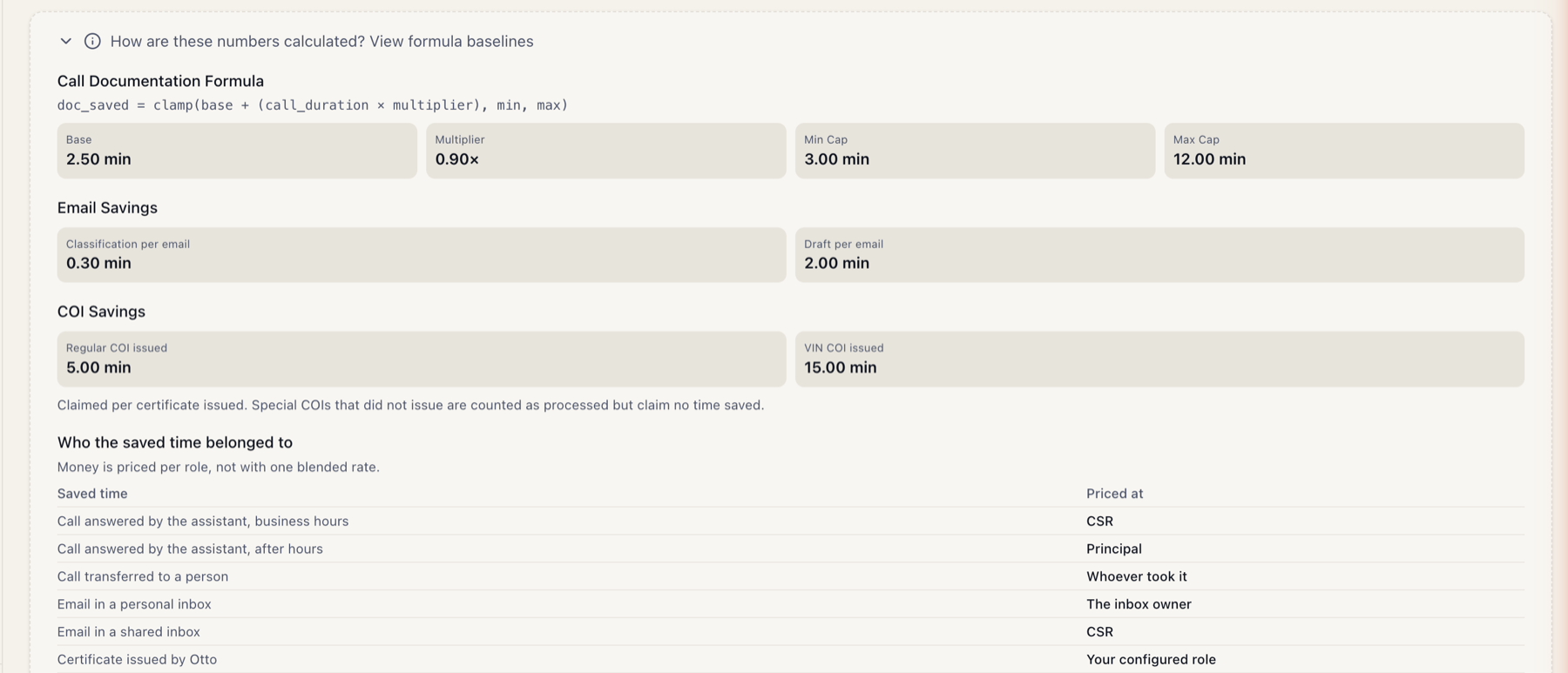
These figures are from our demo workspace, not a customer's. The volumes are modeled on a live agency rather than taken from one, because another agency's traffic is not ours to show, and yours will not be either. Your rates and your book give a different answer, which is the point of the report.
Three leaks, every day.
None of these is a big problem on its own. That is exactly why they never get fixed, and why the total surprises people.
The call that went to voicemail
After-hours and overflow calls go to voicemail. Some are service requests, some are new business, and nobody knows which until morning. Your team starts the day triaging yesterday instead of working the book, and some of those callers never call back.
The COI clock
A certificate is an access document. Until it arrives, your client cannot start the job, and in trucking a slow cert means the load goes to another carrier. And by hand, a request that lands at 7pm is not ten minutes late, it is a whole night late.
The inbox that buries the real work
Your shared service inbox carries carrier bulletins, newsletters, marketing and bulk mail, with real client work buried inside it. Someone senior sorts it every day. That is licensed time spent on work that does not need a license.
Questions people ask about this number.
Does my payroll actually go down?
No, and we will not pretend it does. Nobody gets made redundant when you switch this on, so the hours your team gets back are capacity, not a cheque. What changes is what your licensed people spend the day on, whether you need the next service hire to keep growing, and whether the after-hours callers who today reach a voicemail box get answered and logged instead.
Where does the lead number come from?
From measurement, not a guess. In one production month we counted how many after-hours calls at a live agency produced a new lead logged in the CRM: 4% of them. We measured the rate on after-hours calls and we apply it only to your after-hours calls, because your daytime calls already reach a human. We are not claiming credit for business you already win.
Why is there no revenue number on the leads?
Because we would have to invent it. Turning a captured lead into dollars takes your close rate and what a client in your book is worth per year, and we know neither, and a calculator that guesses those two numbers is a calculator you cannot trust. So the leads stay what they are, measured counts, and the only money on the page is hours priced at rates you set. What those leads close into is a conversation about your book, and a better one to have on a call.
What if the numbers come out small?
Then we are probably not the right fit yet, and we would rather you saw that here than three calls in. The agencies this pays back for are the ones where the phone rings after hours, certificates go out daily, and the service inbox is somebody’s whole morning. If your volumes are low, tell us on a call and we will say so honestly.
Do I still need to hire?
That stays your call. Your payroll does not drop when you switch this on, and nobody is made redundant. What changes is what your licensed people spend the day on: the certificates, the after-hours calls and the inbox sorting come off their desks, and those hours go back to renewals, remarketing and the clients who need a licensed person. Whether you need the next service hire to keep growing is a decision you make with those hours in hand, and the work scales with your book either way.
Do I get this number again once we are live?
You get a better one. The Proof of Value dashboard in your portal runs the measured formulas against your own traffic and updates daily, so you are looking at what actually happened in your agency rather than a projection on a website.
How do I know the calculator is not just marketing?
Because you can check it. Every rate in it comes from one real production month at a live agency, and the per-task rates are printed on the page under "How this is calculated". The per-call rate is blended across every call that month, including the ones transferred to a human and the ones where nobody picked up the transfer, so it is deliberately conservative. What an hour costs in your agency is yours to set, and leads stay measured counts rather than invented revenue, because we do not know your book and will not guess at it. Once you are live, your own portal runs the measured formulas on your own traffic.
Now put a price next to it.
Fifteen minutes with Aiste, our CRO. Written quote the same day.